
Blog
PMC Charges in Construction (2026): Fee Models, Typical Ranges, Scope and Whether It’s Worth It

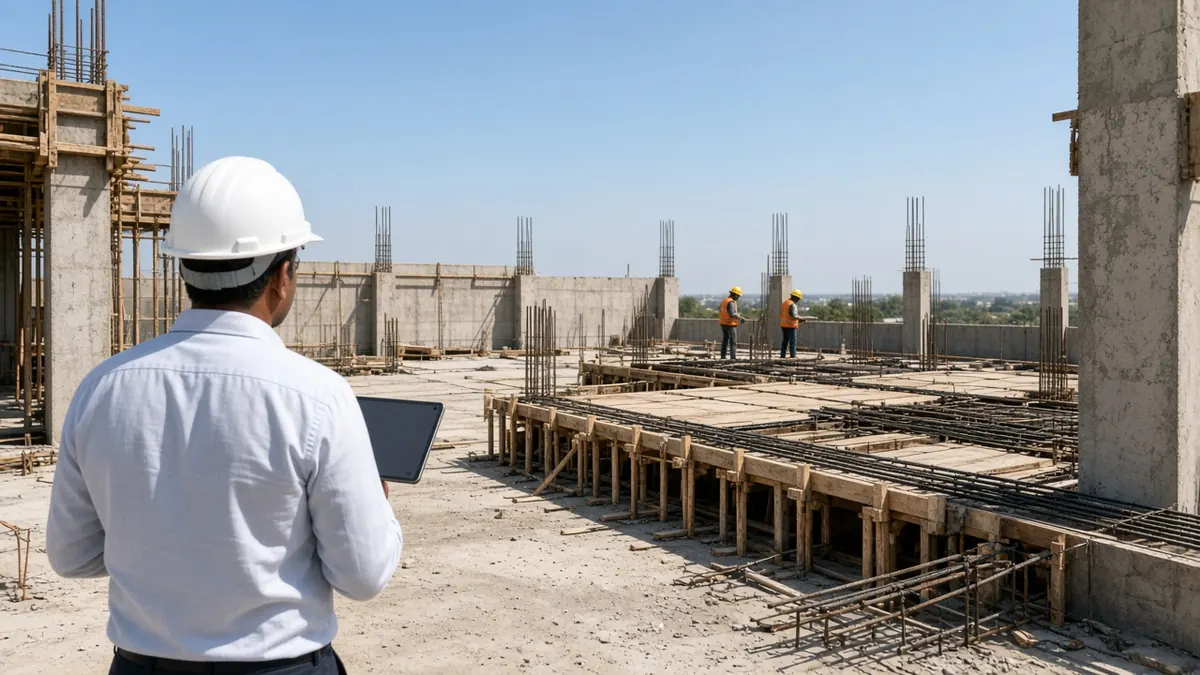
Quick answer: A PMC (project management consultant) is the owner’s representative on site. They plan the schedule, check drawings and BOQs, inspect quality at each stage and certify contractor bills before you pay. PMC charges are usually a percentage of construction cost, a flat per-sq-ft fee, a fixed fee or a monthly retainer. In the 2026 market, home projects are commonly quoted at a low- to mid-single-digit percentage of construction cost, full-scope independent supervision at around 6–10%, and flat fees of around ₹130 per sq ft are advertised in Coimbatore. These are market figures, not Infraura’s fee. A PMC is most useful when you are not on site every day, or when you have a labour-only contract and need someone checking quantities and quality for you.
Building a home is usually the largest purchase a family makes, yet many owners in Coimbatore manage it in the evenings and at weekends. That is where the questions start: “Is a PMC worth paying for?”, “Should I go turnkey or hire labour and a site engineer myself?”, “Is self-managing actually worth it?” This guide answers them in plain terms, with a worked fee example and checklists you can use when you appoint one.
What is a PMC in construction?
“What is PMC in construction” is the most searched project management question we found. In simple terms, a project management consultant works for you, not for the contractor. Their job is to make sure the building you paid for is the building you get, on a timeline you agreed to.
What a PMC does day to day
- Before construction: reviews drawings for clashes, checks the BOQ against the drawings, helps compare contractor quotes on a like-for-like basis, and sets up the contract with milestones and variation rates.
- During construction: inspects work at critical stages (footing, column, slab reinforcement, waterproofing, electrical and plumbing before plastering), tracks progress against the schedule, and flags problems before they are buried in concrete.
- Money control: measures work done, checks contractor bills against the BOQ and certifies payments.
- Handover: prepares a snag list, checks that the snags are closed, and collects warranties and as-built drawings.
Construction management vs project management
Construction management usually refers to running the site itself: labour, materials and sequencing. Project management covers the owner’s whole interest: budget, schedule, quality, contracts and coordination between the architect, contractor and interior team. A PMC sits on the owner’s side of that line.
PMC vs architect vs contractor vs turnkey builder
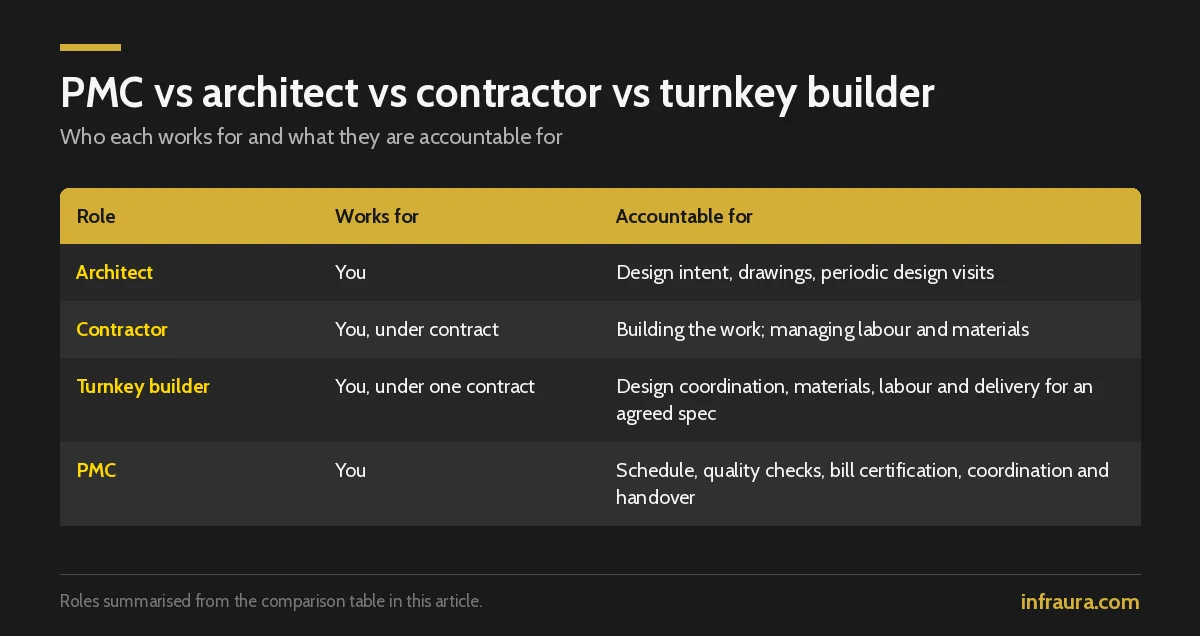
| Role | Who they work for | What they are accountable for | What they don’t do |
|---|---|---|---|
| Architect | You | Design intent, drawings, periodic design visits | Daily supervision, bill checking (unless agreed) |
| Contractor | You, under contract | Building the work and managing labour and materials | Independently checking their own quality and bills |
| Turnkey builder | You, under one contract | Design coordination, materials, labour and delivery for an agreed spec | Acting as an independent check on themselves |
| PMC | You | Schedule, quality checks, bill certification, coordination and handover | Building the work |
How PMC charges are structured
Scope varies so much between projects that a single “market rate” can mislead. Understand how fees are structured first, so that you can compare offers fairly.
| Fee model | How it works | Watch out for |
|---|---|---|
| Percentage of project cost | Fee rises with construction value | Check how “project cost” is defined and whether interiors are included |
| Flat per sq ft | Fee = built-up area × agreed rate | Confirm visit frequency, testing and reporting are inside the rate |
| Fixed fee | One amount for a defined scope | Get site visits and reporting frequency in writing |
| Monthly retainer | Paid for each month of involvement | Delays increase your total fee; ask how delays are handled |
| Per-visit or stage inspections | Paid per inspection | Good for owners who only want quality checks |
What PMC fees look like in the market (2026)
| Typical market figure | Basis |
|---|---|
| Around ₹130 per sq ft, flat | Daily supervision, bill audits and quality tests to handover, as advertised in the Coimbatore market |
| Low- to mid-single-digit % of construction cost | Home projects; varies with scope and city |
| About 6–10% of construction cost | Full-scope independent supervision of homes |
| About 1–4% of project cost | Larger commercial and real-estate projects, where fixed effort spreads over a bigger budget |
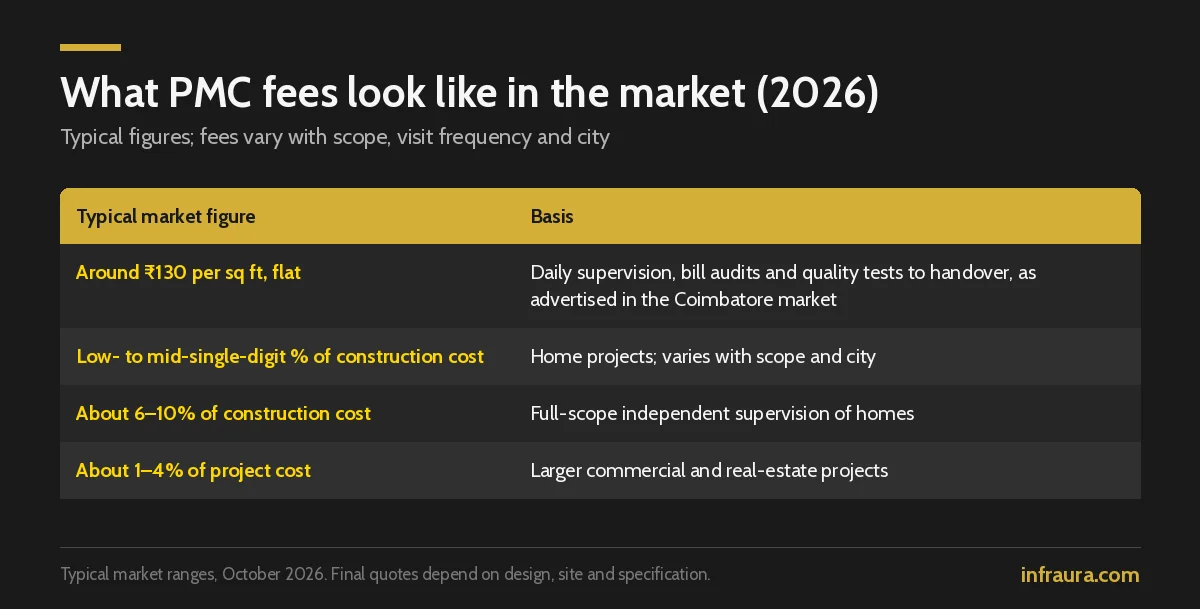
These are typical published ranges, not Infraura’s quote. Actual fees depend on project size, scope, visit frequency and reporting, and Infraura will confirm after a site visit.
Worked example: PMC fee on a 2,000 sq ft home
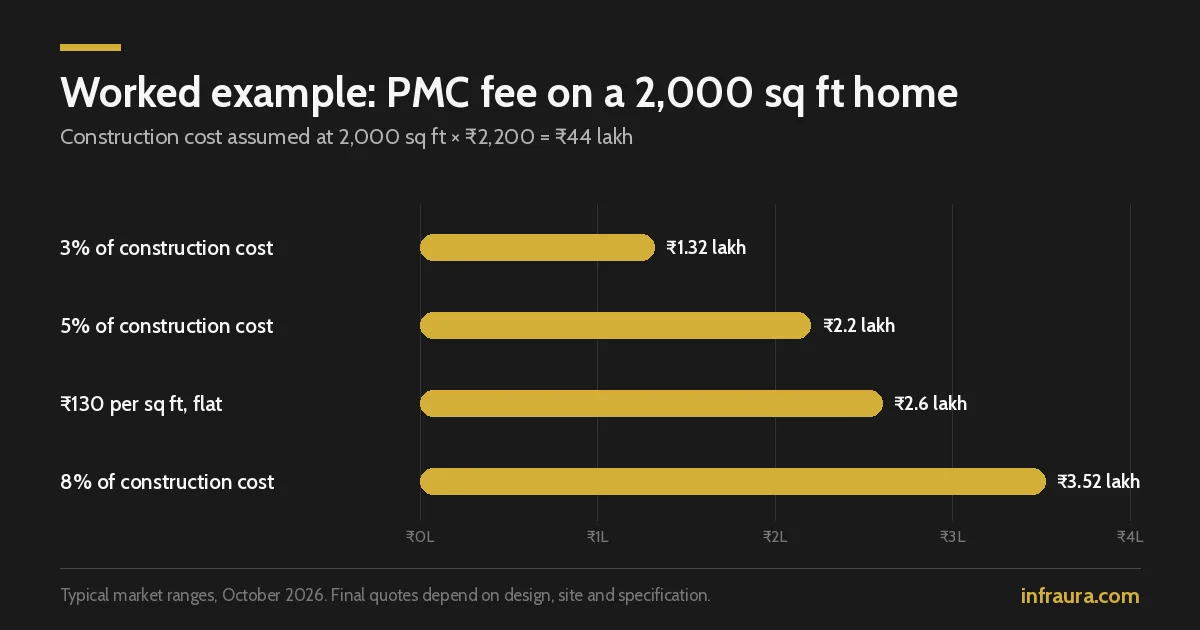
Take a 2,000 sq ft home built at ₹2,200 per sq ft, a construction cost of ₹44 lakh:
| Fee basis | PMC fee |
|---|---|
| 3% of construction cost | ₹1.32 lakh |
| 5% of construction cost | ₹2.2 lakh |
| 8% of construction cost | ₹3.52 lakh |
| ₹130 per sq ft flat | ₹2.6 lakh |
Compare that with the cost of a single missed problem: a waterproofing failure, under-sized reinforcement or an inflated bill. The question is not “is the fee high?” but “what exactly will they check, how often, and who signs off?”
Some homeowners online say they were quoted a percentage that felt high for what was offered. The fix is to ask exactly what you get: visit frequency, who visits (a qualified engineer or a junior supervisor), the reporting format, testing, and whether bill certification is included.
When a PMC is worth it, and when it may be overkill
Usually worth it when:
- You live outside Coimbatore or work full time and cannot visit the site in working hours
- You have a labour-only contract and are buying materials yourself
- The project is large, has a basement or complex structure, or has several contractors
- You are building a commercial or industrial project where delays cost real money
May be overkill when:
- The house is small and simple, and you live next to the site with time to supervise
- A capable architect is already contracted for regular site supervision and bill checking
- You have a turnkey builder with clear specs and you only want a few stage inspections (consider per-visit inspections instead)
Turnkey vs labour-only plus a site engineer: which saves money?
Turnkey
A single company handles design coordination, materials, labour and delivery for an agreed rate and specification.
- Strengths: one point of responsibility, less of your time needed, predictable cash flow if the spec is clear.
- Risks: vague specifications lead to “extras” later, and you rely on the builder’s own quality checks.
See how Infraura approaches turnkey construction.
Labour-only contract with your own procurement and a site engineer
You hire a labour contractor, buy materials yourself and pay a site engineer to supervise.
- Strengths: you control material brands and see every invoice.
- Risks: you carry wastage, theft and storage risk. Coordination between trades falls on you. If something goes wrong, responsibility is split.
Where a PMC fits
A PMC is a layer of protection on top of either model. With turnkey, the PMC checks that the delivered spec matches the contract and that bills match the work done. With labour-only, the PMC brings the planning, quantity control and inspections a single site engineer may not have the time or authority to enforce. Online, commenters often recommend an architect or PMC acting “in your interest” who checks that the BOQ matches the drawings and the site. That is the core value.
Is self-managing actually worth it?
Self-managing can work if you live close to the site, have time during the working day and are comfortable dealing with suppliers and labour. Most owners underestimate the time: daily material decisions, chasing deliveries, checking reinforcement before a pour, and resolving disputes between trades. If you work full time in Saravanampatti’s IT corridor or live outside Coimbatore, the hidden cost is your time and the mistakes you cannot catch.
Is a third-party site supervisor worth the expense?
A good supervisor pays for themselves when they catch problems that are expensive to fix later: poor cover to reinforcement, waterproofing shortcuts, and electrical or plumbing lines that will clash with interiors. Ask any supervisor or PMC for a sample inspection report before hiring.
What a good inspection report contains
- Date, stage and the engineer who inspected
- Photos with location, before and after any correction
- Measurements taken (bar spacing, cover, slab thickness, levels)
- Test results where relevant, such as concrete cube tests
- Non-conformities raised, the fix required and the date it was closed
- Quantities verified against the bill being certified
A stage-wise quality checklist owners can use
- Foundation: excavation depth as per drawings and soil conditions; footing size and reinforcement.
- Columns and beams: bar sizes and spacing as per the structural drawing; cover blocks in place.
- Slab: reinforcement checked before the pour; curing done properly afterwards.
- Masonry and plastering: alignment, wall thickness, plaster finish and curing.
- Waterproofing: roof and bathrooms tested before tiling.
- Services: electrical conduits and plumbing lines checked and pressure-tested before they are covered.
- Interiors: points and conduits coordinated with the interior fit-out plan before plastering.
- Handover: snag list closed; warranties and as-built drawings received.
How to appoint and brief a PMC
- Share your drawings, BOQ and contract (or draft) before asking for a fee.
- Ask for a written scope: visit frequency, who visits, tests included, reporting format and bill certification.
- Confirm independence: the PMC must not be paid by, or related to, your contractor.
- Agree the fee basis and payment stages, tied to project milestones.
- Define authority: can the PMC stop work for a quality failure? Who approves variations?
- Ask for a sample report from a past project.
Red flags
- Fee quoted without seeing drawings or scope
- No named engineer, or “supervision” by an untrained helper
- No written reports, only phone updates
- Reluctance to put visit frequency in writing
How Infraura handles project management
Infraura’s project management consultancy in Coimbatore is scoped project by project. A typical scope covers:
- Design and drawing review for clashes and buildability
- BOQ check against the drawings, and like-for-like comparison of contractor quotes
- Vendor and contractor coordination, including civil, interiors and IT infrastructure on commercial projects
- Stage-wise quality checks at foundation, structure, waterproofing, services and finishing
- Milestone billing verification: measuring work done and certifying bills before you pay
- Schedule tracking with regular progress reporting, and a snag list at handover
The fee is quoted after a scope review, as a percentage of project cost or as a per-sq-ft rate, depending on the project size and the level of involvement you need.
Frequently asked questions
What is PMC in construction?
A PMC (project management consultant) represents the owner on a construction project. They plan the schedule, review drawings and BOQs, inspect quality, certify contractor bills and manage handover.
How are PMC charges in construction calculated?
As a percentage of construction cost, a flat per-sq-ft fee, a fixed fee, a monthly retainer or a fee per inspection. Compare offers on scope: visit frequency, who visits, testing, reporting and bill certification.
How much does a PMC cost for a house?
Typical 2026 market figures range from a low- to mid-single-digit percentage of construction cost to around 6–10% for full-scope supervision; flat fees of around ₹130 per sq ft are also advertised. On a ₹44 lakh home, that is roughly ₹1.3–₹3.5 lakh.
Is the PMC fee included in the construction cost?
No. A PMC is hired separately by the owner so that they stay independent of the contractor. Budget the PMC fee as its own line, next to approvals and professional fees.
Is hiring an independent third-party site supervisor worth the expense?
Usually yes for first-time builders and owners who cannot be on site daily. Catching a reinforcement or waterproofing problem before it is covered is far cheaper than fixing it after.
Turnkey or labour-only contract with a site engineer: which is better?
Turnkey gives one point of responsibility and needs less of your time. Labour-only gives more control over materials but more risk and coordination. A PMC can protect you under either model.
Is self-managing a house build actually worth it?
It can be if you live nearby and have daytime availability. For most working owners, the time required and the mistakes that go unnoticed make professional supervision worthwhile.
Can I hire a PMC after construction has started?
Yes. A PMC can assess the work done so far, record any existing issues in writing and take over supervision from the current stage. The earlier they join, the more they can prevent.
What is the difference between construction management and project management?
Construction management runs the site: labour, materials and sequencing. Project management protects the owner’s overall interest: budget, schedule, quality and contracts.
Is a PMC reliable?
A PMC is only as reliable as their independence and scope. Check that they are not paid by your contractor, ask for sample reports, and get visit frequency and responsibilities in writing.
Talk to Infraura about your project
Whether you have already signed a contractor or are still comparing quotes, Infraura can review your drawings and BOQ and explain what professional oversight would look like for your site. Read about our project management consultancy in Coimbatore, or contact us to arrange a site visit.
Market basis: fee ranges are typical market figures based on Infraura’s review of local and national pricing, October 2026. Final fees depend on project size and scope.