
Blog
Terrace Waterproofing in Coimbatore: Coatings, Membranes and Tiles Compared, and What Affects Cost

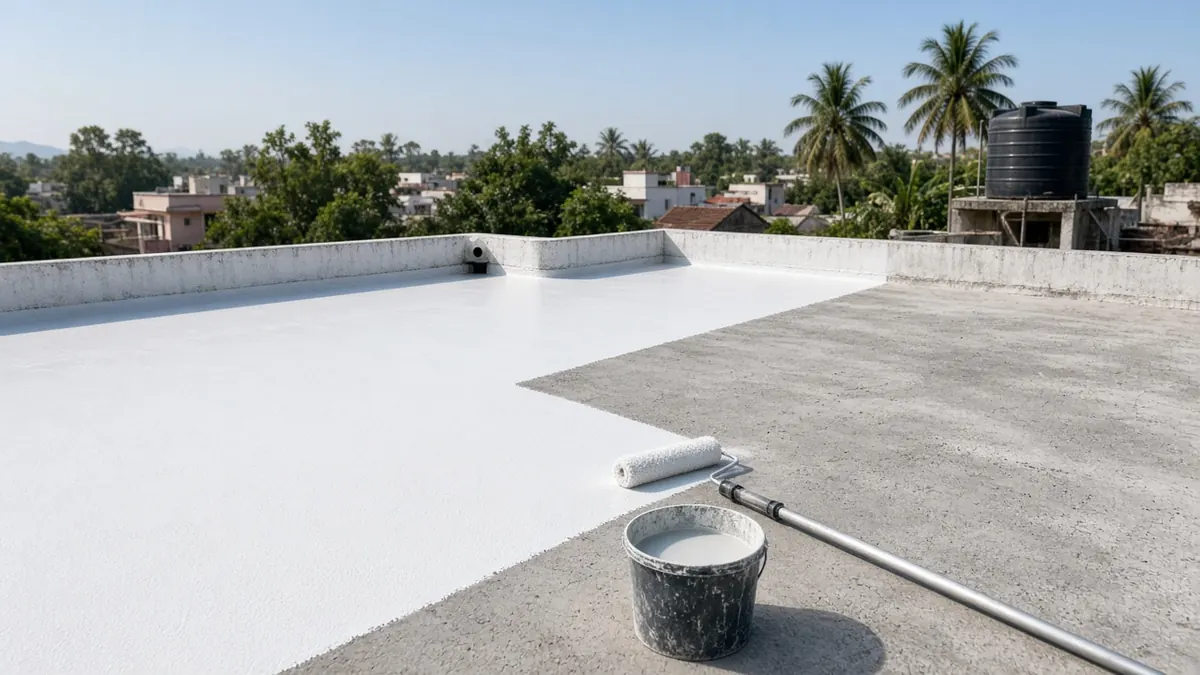
Quick answer: Terrace waterproofing in Coimbatore usually means one of four approaches: a liquid-applied coating, a membrane, a cementitious system, or a protective tile or screed finish over a waterproof layer. The right one depends on the slab’s condition, its slope, how much the surface moves in the heat, and how you use the terrace. Good preparation and detailing at outlets, parapets and pipes matter as much as the product.
If you have already read our guide to roof leakage causes and fixes, you know that the first step is finding the cause. This article picks up from there: once you have decided the terrace itself needs waterproofing, which system should you choose? We compare the main options in plain terms, explain what drives cost, and list the questions to ask before you sign.
Why Coimbatore terraces need the right system
- Heat cycles. Strong daytime sun and cooler nights make the top surface expand and contract, which opens fine cracks over time.
- Monsoon rain. Both the south-west and north-east monsoons bring rain, and ponding water tests every weak point.
- Busy terraces. Water tanks, solar heaters, clothes lines and foot traffic all wear a coating.
Option 1: Liquid-applied coatings
Elastomeric acrylic, polyurethane and similar coatings are applied by roller or brush in layers, often with a reinforcing fabric at cracks and corners.
- Good for: sound slabs with good slope; terraces where you want a seamless, often light-coloured, heat-reflective surface.
- Watch for: correct thickness and number of coats, and protection from heavy foot traffic. Some products need a top coat to resist UV.
Option 2: Membranes
Sheet membranes, such as bituminous or polymer-modified types, are laid and bonded with sealed overlaps. Some are left exposed; others are covered with a screed or tiles.
- Good for: terraces with a history of leaks, more movement, or where a thicker, continuous barrier is wanted.
- Watch for: overlaps, edges and upturns at parapets. Membranes are only as good as their joints.
Option 3: Cementitious systems
Polymer-modified cement coatings are brushed or trowelled on and bond well to concrete.
- Good for: use under tiles or a protective screed, wet areas and water tanks.
- Watch for: they are less flexible than elastomeric products, so check whether the chosen product can handle crack movement on an exposed terrace.
Option 4: Tiles or screed over a waterproof layer
Terrace tiles, weathering tiles or a sloped screed are laid over a waterproof layer. Traditional brickbat coba, still seen on older Tamil Nadu homes, is a similar idea.
- Good for: terraces with regular foot traffic, and for adding mass or slope.
- Watch for: tiles alone are not waterproofing. Water gets through joints, so the layer underneath does the real work. Added weight should be checked by an engineer.
Comparison at a glance
| System | Best suited to | Key check |
|---|---|---|
| Liquid coating | Sound slab, open terrace, heat reflection | Thickness, coats, UV and foot traffic |
| Membrane | Leak-prone or moving slabs | Overlaps, edges, parapet upturns |
| Cementitious | Under tiles or screed, tanks, wet areas | Flexibility for crack movement |
| Tiles or screed over a layer | Heavy-use terraces, slope correction | The waterproof layer below and the added load |
Preparation and detailing: where most jobs succeed or fail
- Clean the surface, and remove loose screed, failed coatings and hollow tiles.
- Repair cracks and honeycombed concrete with suitable products.
- Correct the slope where water ponds.
- Form rounded fillets where the floor meets the parapet.
- Seal around outlets, pipes, tank bases and solar stands, and make outlets sit lower than the surface.
- Apply primer and the system as the manufacturer specifies, with the right curing time.
- Test with water where the system allows, before the terrace is put back into use.
The National Building Code of India 2016 covers roof drainage and waterproofing principles your engineer should follow.
Terrace waterproofing cost: what affects the price
We do not publish a per sq ft rate, because a fair price depends on what the inspection finds. The main factors are:
- The system and number of layers.
- The condition of the surface and how much removal and repair is needed.
- Slope correction work.
- Terrace area, height and access.
- Number of outlets, pipes and fixtures to detail.
- Any protective finish on top.
Ask every applicator to name the product system, the preparation steps, the area and the warranty terms in writing, so you can compare like with like.
Waterproofing, a sheet roof, or both?
Waterproofing seals the slab. A roofing sheet structure over the terrace keeps rain and sun off it and creates covered space. Some homes need both. If heat is your main complaint, see our guide to heat-smart roofing options.
How Infraura helps
Our roofing services include waterproofing and heat-resistant coatings for terraces, along with sheet roofing. For factory and warehouse roofs, our industrial roofing team handles sheet roofs and gutters. If you are building now, our construction services and project management consultancy teams check slope, outlets and parapet details before the terrace is finished, which is the cheapest time to prevent leaks. We do not promise a leak-free life for any product; we explain the system, the preparation and the written warranty before work starts.
Frequently asked questions
Which is the best terrace waterproofing method?
There is no single best method. Liquid coatings suit sound slabs that need a seamless, reflective layer; membranes suit terraces with more movement or a history of leaks; cementitious systems work under tiles or screeds; and tile or screed finishes protect the layer below from sun and foot traffic. The right choice depends on the slab condition, slope and how you use the terrace.
How much does terrace waterproofing cost per sq ft in Coimbatore?
It depends on the system, the condition of the existing surface, the amount of preparation and repair, the area, access, and detailing at outlets and parapets. We do not publish a standard rate. Get a site-specific quote after an inspection, with the product system and preparation steps written down.
Does heat-reflective waterproofing reduce indoor heat?
A light-coloured reflective coating reflects part of the sun's heat, which can make the room below more comfortable. How much depends on the product, the slab and the house. Treat it as a bonus; choose the system first for waterproofing performance.
Can I apply waterproofing during the monsoon?
Most systems need a dry, clean surface and dry weather to bond and cure. The dry months before the monsoon are the best time. Emergency patching is possible in the rains, but a full system should wait for dry conditions.
Should I remove old tiles before waterproofing?
Not always. If the tiles are well bonded and the leak source is clear, some systems can be applied over prepared tiles. If tiles are hollow, cracked or trapping water, they usually need to come off. The inspection should decide this.
How long does terrace waterproofing last?
It depends on the system, the quality of preparation and application, sun and foot traffic, and maintenance. Ask for the manufacturer's and applicator's warranty terms in writing, and inspect the terrace every year before the monsoon.
Talk to Infraura
Have a question about your project? Speak to our team in Coimbatore. We will explain the options plainly and give you a written scope.
- Call / WhatsApp: +91 96771 71707
- Email: support@infraura.com
- Visit: No:1499, Trichy Road, Coimbatore 641018
- Hours: Monday to Saturday, 10 AM to 7 PM