
Blog
Factory and Warehouse Roof Replacement in Coimbatore: When to Repair, Re-sheet or Overclad, plus a Pre-Monsoon Maintenance Checklist

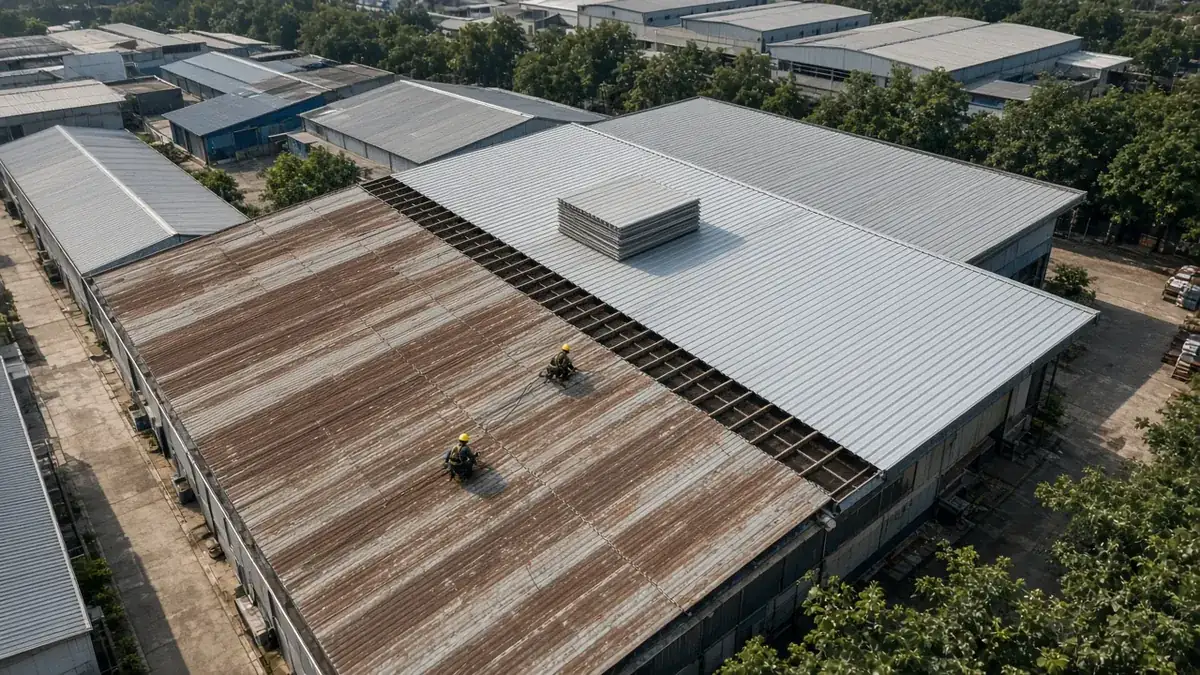
Quick answer: A factory or warehouse roof in Coimbatore needs attention before small problems turn into stock damage and downtime. Repair isolated issues; re-sheet when corrosion, leaks or failed fasteners are widespread; and consider overcladding when you want to add insulation or keep disruption low and the structure can take it. Inspect the roof every year before the monsoon, with a checklist covering sheets, fasteners, laps, ridges, gutters, skylights and safety.
Industrial roofs work hard. They face Coimbatore’s strong sun, two monsoons, dust from production and, in some estates, chemical exposure. A leaking roof can damage stock, machinery and electrical panels, and stop production. This guide explains how to decide between repair, re-sheeting and overcladding, how to plan work around operations, and how to keep a sound roof in good condition with a simple pre-monsoon checklist.
Signs your factory roof needs attention
- Rust spots, flaking coating or white corrosion on sheets.
- Leaks at laps, fasteners, ridges or skylights.
- Sagging sheets or water ponding on low-slope roofs.
- Loose, missing or rusted fasteners and hardened washers.
- Gutters overflowing, rusting through or pulling away.
- Yellowed or cracked translucent sheets.
- Rising heat complaints from the shop floor.
- Noise in rain that disrupts work, which may point to an insulation need.
Repair, re-sheet or overclad?
| Option | When it fits | Key checks |
|---|---|---|
| Repair | Damage is limited to a few sheets, fasteners, laps or gutter sections | Match the sheet profile and coating; fix the cause, not just the hole |
| Re-sheet (replace) | Corrosion or leaks are widespread; sheets are brittle or perforated; you want a different sheet type or insulation | Condition of purlins and frame; phasing around production; safe removal and disposal |
| Overclad | You want insulation or a new surface with less disruption inside, and the old sheets can stay | Structural check for the extra load; spacer or sub-frame design; condensation control; specialist advice if old sheets contain hazardous material |
A proper roof survey should decide this, not the colour of the rust. Ask the surveyor to report on sheets, fasteners, purlins, gutters and skylights separately.
Choosing the replacement roof
Replacement is a chance to fix more than leaks. Options include coated metal sheets in different profiles, insulated sandwich panels such as PUF for heat and noise, UPVC sheets where chemical exposure is a concern, and translucent sheets for daylight. Ridge or turbo ventilators can help remove hot air. Our article on PUF panel vs GI roofing for industrial buildings compares two common options, and our industrial shed roofing guide covers GI, UPVC and aluminium.
Planning roof replacement around production
- Survey and scope: measure the roof, record condition, and agree the solution.
- Season: plan major roof work for dry months, well before the monsoon.
- Phasing: replace the roof bay by bay so only part of the floor is affected at a time.
- Protection: cover machinery and stock below, and keep exclusion zones under the work area.
- Safety: lifelines, harnesses, edge protection, crawl boards over fragile sheets and safe access. Fragile and translucent sheets are a serious fall risk.
- Coordination: agree working hours, noise and crane movements with your production team.
- Handover: water test, clean gutters and record what was installed.
On larger sites, a project management consultant can manage the scope, contractor comparison, safety and quality checks while your team focuses on production.
Pre-monsoon factory roof maintenance checklist
Use this checklist every year before the monsoon, and after any major storm.
Sheets and coatings
- Check for rust, coating damage, cracks and perforations.
- Touch up cut edges and scratches as the manufacturer recommends.
- Check translucent sheets for cracks and discolouration.
Fasteners and laps
- Replace missing, loose or rusted fasteners and hardened washers.
- Check side and end laps for gaps and failed sealant.
Ridges, flashings and penetrations
- Check ridge caps, flashings at walls and around ventilators, ducts and exhaust pipes.
- Reseal where sealant has cracked or pulled away.
Gutters and downpipes
- Clear dust, leaves and debris from gutters and outlets.
- Check gutter joints, supports and overflow points.
- Make sure downpipes discharge away from foundations and walkways.
Inside the building
- Look for water stains, drips and rust on purlins.
- Check that electrical panels and stock are not under known leak points.
Safety and security
- Check lifelines, ladders and walkways are in good condition.
- Check roof-mounted cameras and cables; our CCTV surveillance team can relocate or add cameras during roof work.
Roof replacement cost: what affects it
We do not publish standard rates, because the main drivers vary by building: roof area and height, sheet type and insulation, purlin and gutter condition, access and safety arrangements, phasing around production, and removal and disposal of old sheets. Get a site-specific quote after a roof survey, with the scope written down.
How Infraura helps
Our industrial roofing team surveys factory and warehouse roofs, recommends repair, re-sheeting or overcladding, and plans the work around your operations. Our roofing services also cover sheet roofs, waterproofing and heat-resistant coatings for commercial buildings.
Frequently asked questions
When should a factory metal roof be replaced instead of repaired?
Consider replacement when corrosion has spread across many sheets, sheets are perforated or brittle, leaks keep returning after repairs, fasteners and laps have failed widely, or the roof no longer suits the building's use, for example when insulation is needed. Isolated damage can usually be repaired.
What is overcladding?
Overcladding means fixing a new roof sheet system over the existing roof, on new spacers or a sub-frame, instead of removing the old sheets. It can reduce disruption inside, but the structure must be checked for the extra load, and any old roof containing hazardous material needs specialist advice.
How long does factory roof replacement take?
It depends on roof area, access, the condition of purlins and gutters, whether production continues below, weather, and material lead times. Ask for a phased schedule for your building rather than a general estimate.
Can we keep the factory running during roof replacement?
Often yes, by working in phases, protecting equipment below, scheduling noisy or risky work at agreed times, and keeping clear exclusion zones. It needs careful planning with your production team.
How much does industrial roof replacement cost?
It depends on area, sheet type and insulation, condition of the structure and gutters, access and safety arrangements, phasing around production, and disposal of old sheets. We do not publish a standard rate. Get a site-specific quote after a roof survey.
How often should a factory roof be inspected?
At least once a year before the monsoon, and after any major storm. Busy or dusty sites may need gutters cleaned more often.
Talk to Infraura
Have a question about your project? Speak to our team in Coimbatore. We will explain the options plainly and give you a written scope.
- Call / WhatsApp: +91 96771 71707
- Email: support@infraura.com
- Visit: No:1499, Trichy Road, Coimbatore 641018
- Hours: Monday to Saturday, 10 AM to 7 PM