
Blog
Construction Loan Disbursement Stages: How Loan Releases Line Up With Your House Build in Coimbatore

Quick answer: A construction loan is released in parts, called tranches, as your house reaches agreed stages, not as one lump sum. Your own contribution is usually used first, the lender checks progress on site before each release, and each release takes some time. Plan your cash flow stage by stage, keep a buffer for the early stages, and confirm the exact stages and conditions with your lender.
Most families building an independent house in Coimbatore take a loan for part of the cost. The surprise for many is not the EMI. It is the timing. Money does not arrive when the agreement is signed, and the site cannot wait for the bank. This guide explains how stage-wise disbursement works, how it lines up with real construction milestones, and how to plan so your build keeps moving.
Infraura is a builder, not a lender, and does not arrange loans or handle loan paperwork. Loan terms differ between lenders and change over time, so confirm the details of your own loan with your lender before you plan around them.
Why construction loans are released in stages
When you buy a finished house, the asset already exists. When you build, the lender is funding something that grows over months. So the loan is released as the building grows. This is not just lender preference. The Reserve Bank of India’s Master Circular on Housing Finance (2 April 2024, accessed 17 October 2026) says disbursal of housing loans sanctioned to individuals should be closely linked to the stages of construction, and that upfront disbursal should not be made for under-construction houses.
The same circular says that when someone who owns a plot asks for a loan to build, the lender must obtain a copy of the plan sanctioned by the competent authority before sanctioning the loan, and an architect appointed by the bank should certify at various stages that construction follows the sanctioned plan. In practice, this is why approval and stage checks matter so much. Our guide to building plan approval in Coimbatore covers the approval side.
Sanction vs disbursement: two different moments
- Sanction is approval of a maximum amount on stated terms.
- Disbursement is money actually released. For a construction loan, it comes in tranches over the build.
Interest is generally charged on the amount released, not on the full sanctioned amount, which is why the monthly outgo during construction grows as more tranches are released. Our guide on pre-EMI and full EMI explains the repayment side.
How loan stages line up with real construction stages
Every lender writes its own stage list, and your sanction letter is the document that matters. The construction sequence on site, though, is broadly the same for most independent houses. Seeing the two side by side helps you plan.
| Construction stage on site | What it involves | Planning note |
|---|---|---|
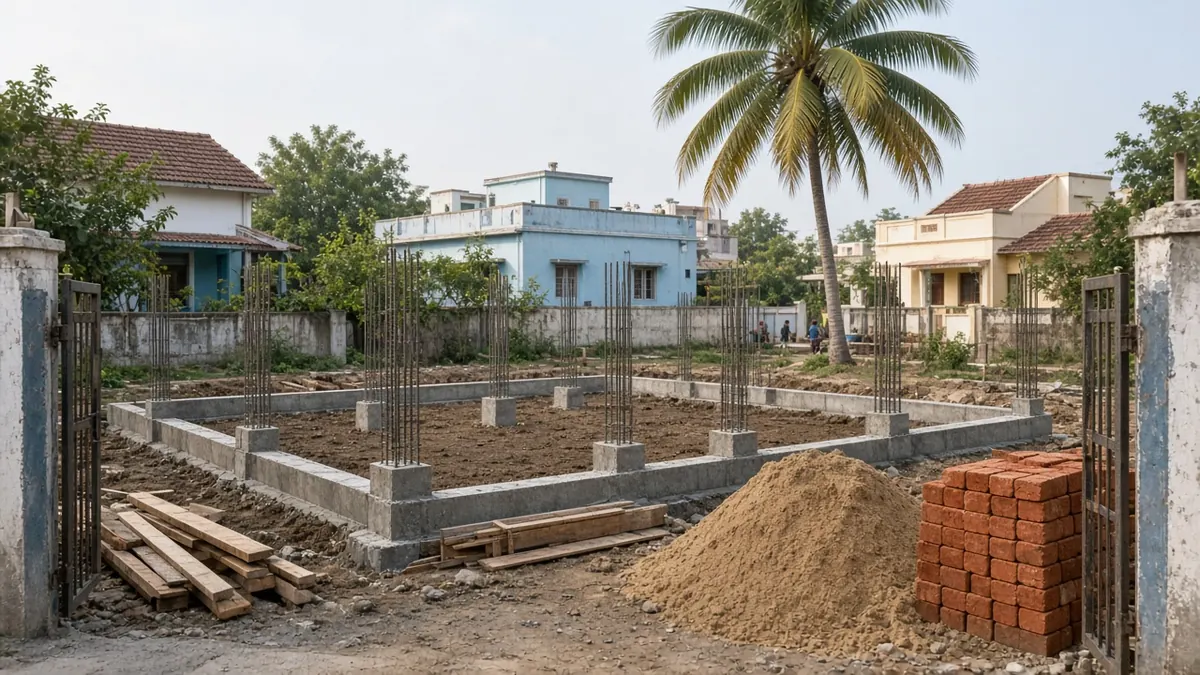
| Site setup and foundation | Marking, excavation, footings, columns to plinth, plinth beam | Often funded from your own contribution before the first release |
| Superstructure | Columns, beams, slabs floor by floor, brick or block walls | Slab-by-slab progress is easy for a lender to verify on site |
| Roof and services | Top slab, terrace slope, conduits and plumbing lines | Services must be in before plastering, so do not delay decisions |
| Plastering and flooring | Internal and external plaster, waterproofing, tiling | Bathroom waterproofing must be tested before tiles go on |
| Finishing | Doors, windows, painting, fixtures, kitchen, wardrobes | Many trades at once; often takes longer than expected |
For a fuller walk-through of each stage, see how a house is built in Coimbatore, step by step.
Footing or plinth? Pin down what “foundation completed” means
A question that comes up again and again among homeowners is what a lender means by “foundation completed”. Some take it as the footing; others mean work up to plinth level. The difference matters, because everything before that point usually comes out of your own pocket. Ask the lender to state the trigger for the first release in writing.
Plan your cash flow before the first brick
- Ask your builder for a stage-wise work schedule. A schedule showing when each stage is expected lets you see what is coming and plan your own funds around it. If you are still choosing a builder, see our construction services.
- Map your own contribution to the early stages. Advance, site setup, foundation and plinth are commonly paid before the loan starts flowing.
- Keep a buffer. Releases involve a site visit and approval, so money may arrive some time after a stage is finished. A buffer stops the site from stopping.
- Keep the build on the approved plan. Deviations can lead to questions at inspection time.
- Keep records. Dated site photos, invoices and receipts for each stage make life easier for everyone, including you at tax time.
Our construction cost calculator gives a starting point for the overall budget you will be splitting between your own funds and the loan.
What usually slows releases down
- A stage that is “almost” done rather than complete.
- Construction that departs from the sanctioned plan.
- Missing invoices or unclear records of what was spent.
- Owners not having their share ready when the lender expects it.
- Late design decisions that hold up the next stage of work.
Where independent supervision helps
If you are building with your own contractor, a project management consultant can track progress against the schedule, check quality at each stage and verify contractor bills before you pay. A PMC works for you on the construction side. It does not deal with your lender.
Don’t forget the finishing stage
Interiors and wiring decisions belong early, even though they are installed late. Smart switches, CCTV and data points need conduits before plastering. Talk to our smart home team during design, and bring in the turnkey interiors team early so kitchen, wardrobe and ceiling plans are settled before the walls are closed.
Frequently asked questions
Why is a construction loan not released in one go?
Because the house does not exist yet. Lenders release money as the building takes shape, so the amount out on loan stays in line with the value of what has been built. RBI's housing finance instructions to banks say disbursal to individuals should be closely linked to the stages of construction.
When does the first disbursement usually come?
It depends on the lender and your sanction terms. Many homeowners find that their own contribution is used first and the first release comes only after an early milestone such as the foundation or plinth. Ask your lender, in writing, exactly which stage triggers the first release.
What is the difference between loan sanction and loan disbursement?
Sanction is the lender's approval of a maximum amount on stated terms. Disbursement is the actual release of money, which for a construction loan happens in parts as work progresses.
What is tranche disbursement?
A tranche is one part-payment of the sanctioned loan. A construction loan is usually released in several tranches, each tied to progress on site.
How long does each release take?
There is no fixed time. Each release usually involves a site visit and internal approval by the lender, so build a buffer into your plan rather than assuming money arrives the day a stage is finished.
Does a change to my approved plan affect releases?
It can. Lenders check that construction follows the sanctioned plan, so deviations can cause questions or delays. Settle the design before work starts and avoid changes that move away from the approved plan.
Talk to Infraura
Have a question about your project? Speak to our team in Coimbatore. We will explain the options plainly and give you a written scope.
- Call / WhatsApp: +91 96771 71707
- Email: support@infraura.com
- Visit: No:1499, Trichy Road, Coimbatore 641018
- Hours: Monday to Saturday, 10 AM to 7 PM