
Blog
Smart Lighting for Coimbatore Homes: Smart Switches vs Smart Bulbs, Scenes and What to Pre-wire

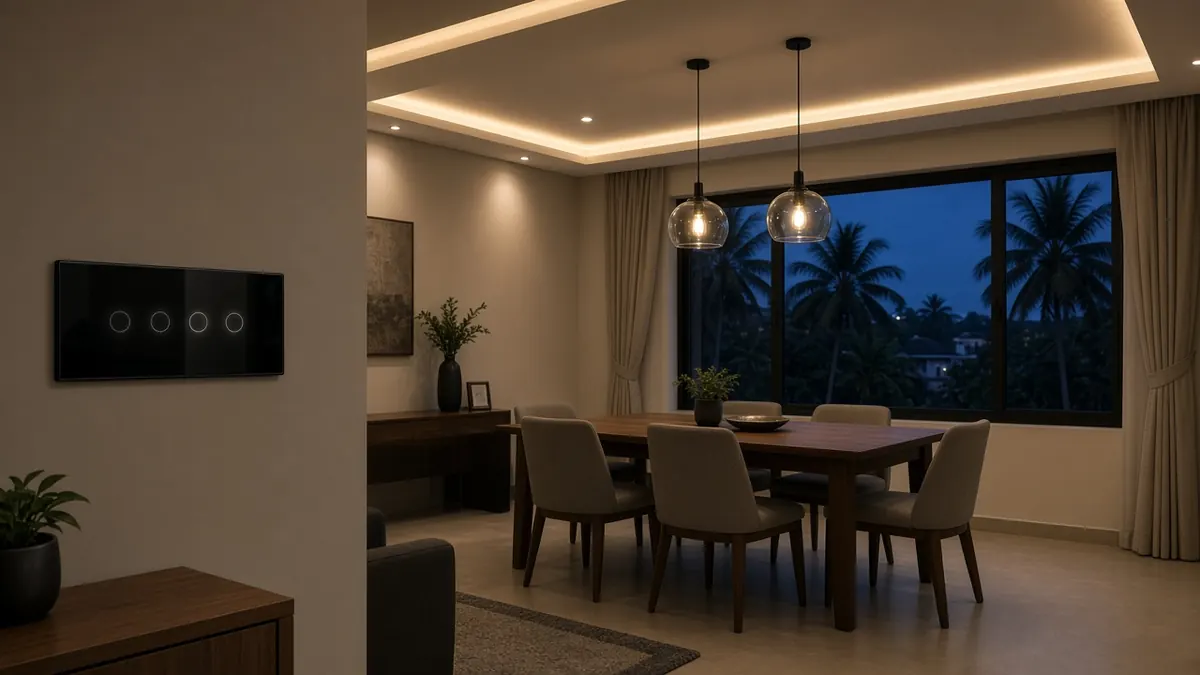
Quick answer: For most Coimbatore homes, smart switches are the better base for smart lighting, because they work with every fitting on the circuit and with the normal wall switch. Use smart bulbs for lamps, colour effects or rented homes. Plan scenes room by room, add motion sensors in corridors and staircases, and, if you are building or renovating, pre-wire a neutral to every switch box and deep boxes where the switch panels will go.
Smart lighting is usually the first thing people automate, and the most used. Done well, it means one touch for “movie”, lights that come on as you walk down the stairs at night, and outdoor lights that follow sunset. Done badly, it means lights that will not turn on when the Wi-Fi is down. This guide explains the choices in plain words, for homes in Coimbatore.
Smart switches vs smart bulbs
| Factor | Smart switches | Smart bulbs |
|---|---|---|
| What it controls | Any light on the circuit: ceiling, cove, downlights, fans (with suitable modules) | Only that bulb |
| Wall switch | Stays the control point; works for family and guests | If someone turns off the wall switch, the bulb goes offline |
| Wiring | Installed in the switch box; may need a neutral wire | None; screw in and pair |
| Colour and tunable white | Depends on the fittings and drivers | Common |
| Best for | New homes, renovations, whole-home control | Rented homes, lamps, accent lighting |
Many homes use both: smart switches for the main lighting, and a few smart bulbs or strips for mood lighting.
What makes smart lighting useful: scenes, sensors and schedules
Scenes
A scene sets several lights at once with one touch or voice command. Plan them room by room:
- Living room: “Welcome”, “TV”, “Guests”, “All off”.
- Dining: pendant on, cove dimmed.
- Bedroom: “Reading”, “Night” with a low path light, “Good morning”.
- Whole house: “Leaving home” switches off everything except security lights.
Sensors
- Motion sensors in staircases, corridors, store rooms and toilets, so lights turn on and off automatically.
- Low-level night lights in corridors for elders and children.
Schedules
- Gate, compound and garden lights that follow sunset and sunrise.
- Random “presence” lighting when you are travelling.
Dimming and fittings
Dimming makes the biggest difference to how a room feels, but not every LED fitting dims smoothly. Check that the drivers and fittings are dimmable and compatible with the chosen switches, especially for cove strips and downlights in a false ceiling. A mismatch causes flicker or buzzing.
What to pre-wire during construction or renovation
If your home is still at the wiring stage, this is the cheapest time to get smart lighting right:
- Neutral wire at every switch box. Many smart switches need it.
- Deeper or larger switch boxes where smart panels and modules will go.
- Separate circuits for lighting groups you want to control separately, such as cove, downlights and pendants.
- Conduits to sensor positions in corridors and staircases.
- Outdoor lighting circuits brought back to a controllable point.
- Network cabling or access point positions so the system has a reliable connection.
Our guide to planning home automation during construction covers the full pre-wiring checklist.
Reliability: what happens when the internet goes down?
Ask every supplier how the system behaves offline. A good system:
- Keeps the wall switches working at all times.
- Runs scenes and sensors locally, without depending on the cloud.
- Recovers its settings after a power cut.
Strong home Wi-Fi or wired network coverage matters too. Our networking and structured cabling team can plan access points so the lighting system does not drop out in far rooms. For security questions such as passwords and app access, read is home automation safe?
Smart lighting for offices
The same ideas apply in offices: sensors in cabins, washrooms and corridors, schedules for common areas, and scenes for meeting rooms. Plan circuits with the office fit-out so the control is simple for staff.
Smart lighting cost: what affects it
We do not publish a standard rate, because cost depends on the number of rooms and circuits, switch panels and modules, sensors, dimming, the control system, network needs and installation. Ask for a room-by-room plan with the scenes listed, so you know exactly what you are paying for.
How Infraura helps
Our smart home services team designs lighting control with you room by room, from scenes to sensors. When lighting is part of a renovation, our turnkey interiors team plans false ceilings and fittings around it, and for new builds our construction team fixes the wiring before plastering.
Frequently asked questions
Are smart switches or smart bulbs better?
For whole-home lighting, smart switches are usually better because they keep working with the normal wall switch, control any fitting on the circuit, including ceiling and cove lights, and do not depend on each bulb. Smart bulbs suit renters, single lamps and colour effects, but they stop being smart if someone turns off the wall switch.
Do smart switches need a neutral wire?
Many smart switches need a neutral wire at the switch box to power themselves. Some are designed to work without one. Check this before you buy, and if you are building, run a neutral to every switch box.
Will smart lights work if the internet goes down?
It depends on the system. Systems that control lights locally, through a hub or local network, keep basic switching and scenes working without internet. Cloud-only products may lose app and voice control. Ask how each function works offline.
Can I add smart lighting to an existing home without rewiring?
Often yes. Retrofit smart switches can replace existing switch modules if the boxes have space and the right wiring, and smart bulbs need no wiring at all. A site check will show what is possible.
How much does smart lighting cost?
It depends on the number of circuits and rooms, switch type, sensors, dimming, the control system and installation. We do not publish a standard rate. Get a site-specific quote with a room-by-room lighting plan.
Do smart lights save electricity?
They can, by turning lights off in empty rooms with sensors, dimming, and schedules, especially in corridors, staircases and outdoor areas. Savings depend on how you use them.
Talk to Infraura
Have a question about your project? Speak to our team in Coimbatore. We will explain the options plainly and give you a written scope.
- Call / WhatsApp: +91 96771 71707
- Email: support@infraura.com
- Visit: No:1499, Trichy Road, Coimbatore 641018
- Hours: Monday to Saturday, 10 AM to 7 PM